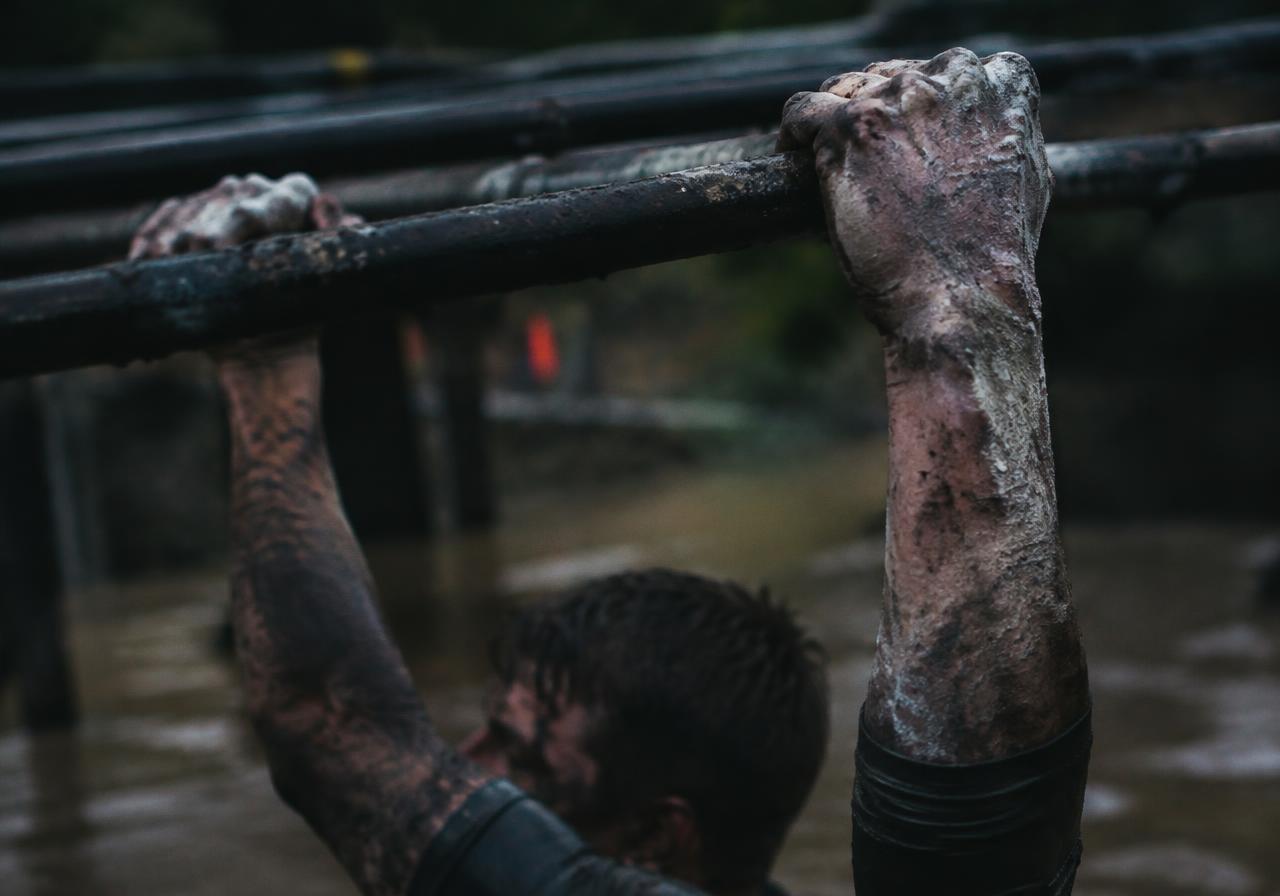
Monkey bars and rigs
Swing, don't pull. How to cross bars, rings and multi-rigs without burning your grip.
Technique
Use momentum from your hips rather than pulling with your arms.
- Keep arms slightly bent and shoulders engaged — never hang passively.
- Swing from the hips and reach on the forward arc.
- Skip a bar when the swing allows; fewer grabs = less fatigue.
- Wipe hands on dry clothing or grass before the obstacle.
Training drills
Dead hangs, active hangs, single-arm hangs, and playground bar traverses after running to simulate fatigue.
Walls (2 m to 2.7 m)
Getting over high walls with a run-up, a kick and a hook.
Technique
Speed and footwork beat raw strength.
- Take 3–4 fast steps and plant one foot high on the wall.
- Drive up and grab the top with both hands.
- Hook a heel over the top, then roll your body across.
- Lower yourself down — don't jump from the top onto uneven ground.
Training drills
Pull-ups, explosive step-ups and practising on local walls or OCR gym walls.
Rope climb
Use your feet: the J-hook and S-wrap let your legs do the work.
Technique
Lock the rope with your feet so you can stand up and rest.
- J-hook: rope runs down the inside of one leg, across the top of that foot, and the other foot pinches it.
- Stand up, reach high, re-lock the feet — repeat.
- Descend hand-under-hand with feet controlling the speed. Never slide.
Training drills
Practise foot locks while seated on the floor, then on a rope at an OCR gym or climbing centre.
Bucket, sandbag and log carries
Posture and breathing for heavy carries up and down hills.
Technique
Hold the load close to your centre of mass and keep a tall spine.
- Bucket: hug it high against your chest, resting on your hips during downhills.
- Sandbag: drape over one shoulder and switch sides as needed.
- Short steps uphill, controlled steps downhill.
- Breathe rhythmically; don't hold your breath.
Training drills
Sandbag and bucket walks on hills, farmer's carries and front-loaded squats.
Barbed-wire crawls and water obstacles
Staying low, rolling, and staying safe in cold water.
Crawls
Crawl on forearms and knees, or roll sideways on flat sections — rolling is often faster and easier on the elbows.
Water and cold
Enter cold water slowly when allowed, exhale steadily to control the gasp reflex, and keep moving once out.
- Never dive head-first into muddy water — depth is unknown.
- If you are not a confident swimmer, use rope lines or ask marshals for the bypass.
Spear throw and traverse walls
Two skill obstacles that cost the most penalties.
Spear throw
Hold the spear at its balance point, aim slightly above the target, and throw with a straight arm follow-through. Check the rope isn't tangled before you throw.
Traverse wall
Keep hips close to the wall, arms straight, and move feet first. Use the bottom ledge for your feet whenever possible.